Reception Desk Cabinets Exporter
Reception Desk Cabinets Exporter
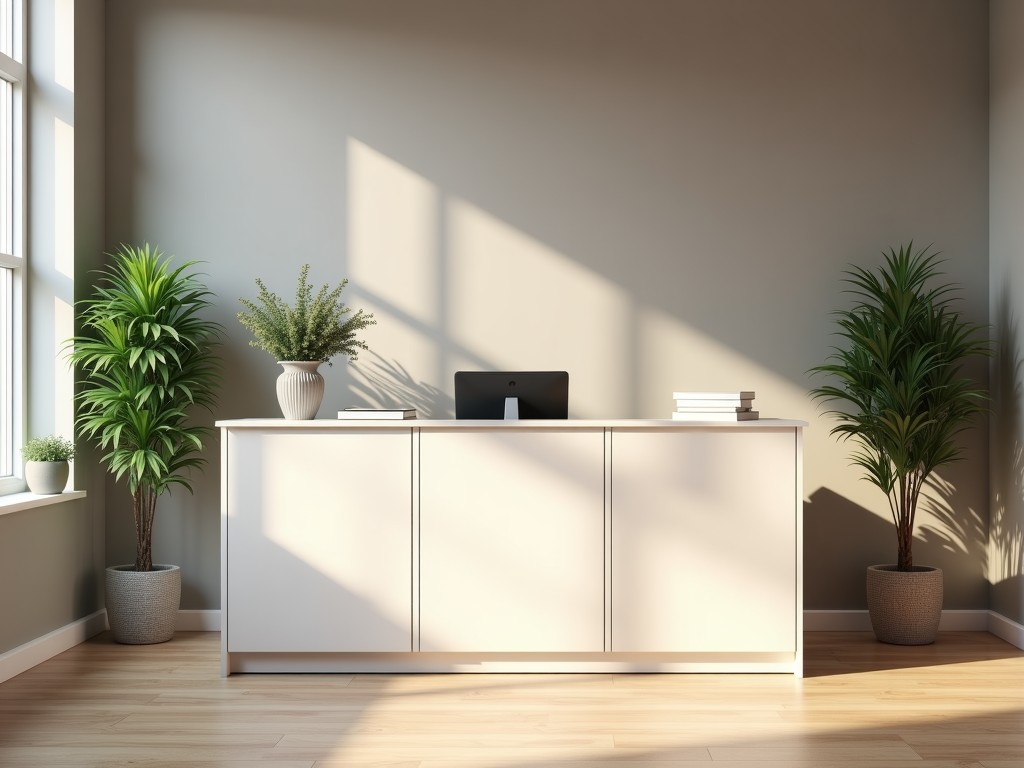
Reception Desk Cabinets for Commercial and Institutional Environments
In high-traffic reception areas, cabinetry must balance durability, aesthetics, and functional storage while enduring constant use, cleaning protocols, and varying environmental conditions. Standard furniture often fails to meet the combined demands of impact resistance, surface hygiene, and long-term dimensional stability required in lobbies, healthcare facilities, corporate offices, and educational institutions.
Material Selection for Hygienic and Durable Surfaces
The choice of substrate and finish directly affects resistance to scratches, moisture, and chemical exposure from disinfectants. We specify high-density fiberboard (HDF) or moisture-resistant particleboard cores with thicknesses ranging from 18mm to 25mm, depending on load requirements and span. These cores are bonded with thermally fused melamine (TFM) or high-pressure laminate (HPL) surfaces, selected based on abrasion class (AC3–AC5) and chemical resistance ratings per NEMA LD 3 standards.
For environments requiring frequent cleaning with alcohol- or bleach-based solutions, HPL with a melamine formaldehyde resin system provides superior surface integrity compared to standard TFM, reducing the risk of delamination or discoloration over time. Edge sealing with PVC or ABS edgebanding, minimum 2mm thick, prevents moisture ingress at vulnerable joints — a common failure point in lower-grade cabinetry.
Construction Methods Ensuring Structural Integrity
Unlike flat-pack alternatives that rely on cam locks and plastic connectors, our reception desk cabinets employ a combination of confirmat screws, dowel reinforcement, and routed dado joints for critical load-bearing connections. This method increases shear resistance by approximately 40% compared to cam-only assemblies, reducing joint creep under sustained loads from monitors, printers, or frequent leaning.
Drawer systems use full-extension, soft-close ball-bearing slides rated for 35–50kg dynamic load, with anti-rebound mechanisms to prevent drift in high-vibration zones. Interior shelving incorporates adjustable pin systems with 32mm spacing, allowing reconfiguration without tools while maintaining load capacity of up to 40kg per shelf when properly supported.
Typical Specifications and Dimensional Flexibility
| Parameter | Typical Range / Option | Notes |
|---|---|---|
| Overall Height | 720mm – 1100mm | Adaptable to seated or standing reception positions |
| Depth | 500mm – 650mm | Balances knee clearance and storage capacity |
| Core Material | HDF / MR Particleboard | 18–25mm thickness, density >800kg/m³ |
| Surface Finish | TFM (AC3) or HPL (AC4–AC5) | HPL recommended for healthcare and high-traffic zones |
| Edgebanding | 2mm PVC or ABS | Melamine-glued, radius-free edges available |
| Drawer Load Capacity | 35–50kg per drawer | Full-extension, soft-close, anti-rebound slides |
| Shelf Load Capacity | Up to 40kg | With center support for spans >800mm |
| Leg Levelers | Adjustable ±15mm | Steel base, nylon pad for floor protection |
| Optional Features | Cable grommets, locking mechanisms, integrated power/data | Custom cutouts available per drawing |
Application-Specific Design Considerations
In healthcare reception zones, cabinets often incorporate rounded front edges and seamless countertop extensions to minimize injury risk and simplify cleaning. For corporate environments, cable management is prioritized through rear-mounted grommets and vertical raceways, reducing clutter from multiple devices. Educational installations frequently require heightened impact resistance, leading to specification of HPL surfaces with post-forming capabilities for curved edges that resist chipping.
All designs account for ergonomic clearance: minimum 600mm knee height and 400mm depth beneath the counter surface to comply with accessibility guidelines. Overhead storage, when included, maintains a minimum 1800mm clearance from finished floor to prevent head contact.
Quality Control and Consistency
Each cabinet undergoes dimensional verification at critical junctions — diagonal tolerance within ±2mm, squareness deviation <1.5mm over 1000mm, and surface flatness deviation <0.5mm per 300mm length. Finish adhesion is tested via cross-hatch tape test (ASTM D3359), requiring minimum 4B rating for HPL surfaces. Edgebanding bond strength is verified through peel resistance testing, ensuring minimum 1.8 N/mm to prevent delamination under thermal cycling.
Packaging uses corner protectors, edge foam, and five-layer corrugated cartons with internal bracing to withstand pallet stacking and transit vibration. Units are shipped flat-pack or pre-assembled based on project logistics and installation constraints.
Customization and Project Support
We accept DXF, DWG, or PDF specifications for custom sizing, cutouts, and hardware integration. Material substitutions — such as fire-retardant cores (UL 94 V-0) or antimicrobial surfaces — are available upon request. Lead time typically ranges from 3–6 weeks for standard configurations, extending to 8–10 weeks for projects requiring special material sourcing or custom tooling.
Minimum order quantities apply for customized finishes or non-standard dimensions; standard models are available from single units. Engineering support includes load simulation for unique configurations and clearance validation for ADA or local compliance requirements.
Share your drawings or specifications for a customized proposal.