Gray Built In Cabinets Exporter
Gray Built In Cabinets Exporter
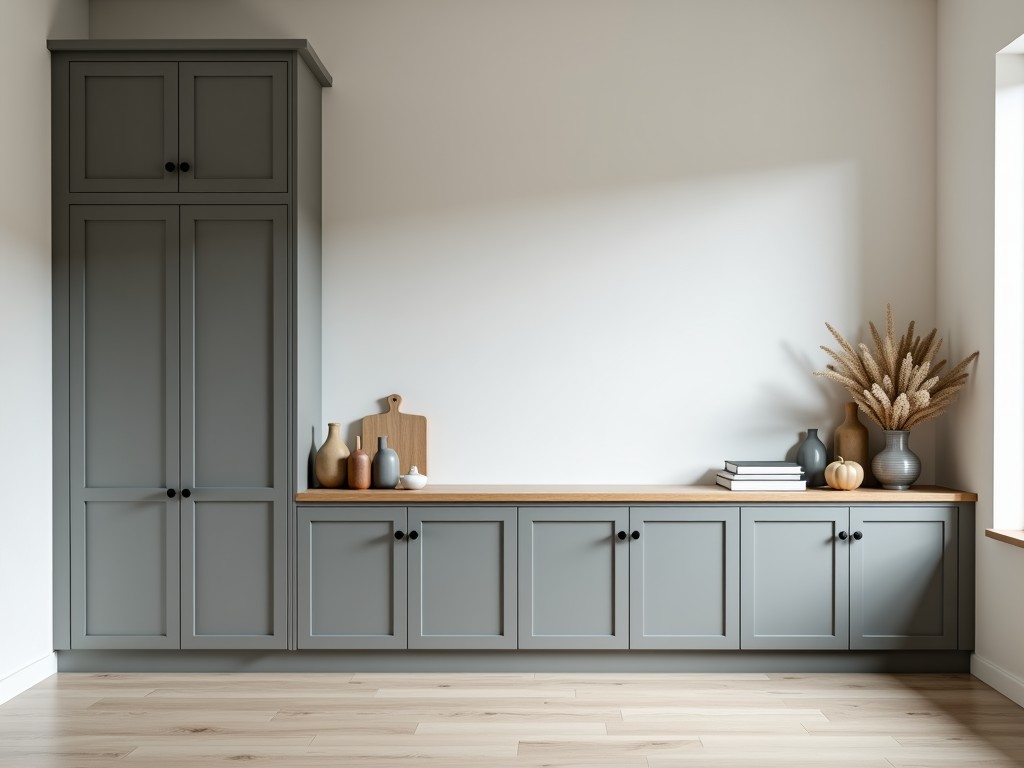
Gray Built-In Cabinets for Industrial Storage and Equipment Protection
In manufacturing facilities, workshops, and technical environments, storage solutions must balance durability, space efficiency, and environmental protection. Gray built-in cabinets address these needs by integrating directly into wall systems or workstations, offering a permanent, low-profile enclosure for tools, components, documentation, or sensitive equipment. Unlike freestanding units, their fixed installation minimizes floor footprint and reduces movement-related wear, making them ideal for high-traffic or precision-dependent areas where consistent access and protection are critical.
The neutral gray finish is not merely aesthetic — it reduces visual glare under bright industrial lighting, minimizes the appearance of dust and minor scuffs, and provides a consistent backdrop for labeling or color-coded organization systems. This makes them particularly suitable for environments requiring visual clarity, such as assembly lines, inspection stations, or control rooms where operator focus and equipment longevity are priorities.
Material Selection and Structural Integrity
The performance of built-in cabinets begins with material choice. Common substrates include cold-rolled steel, galvanized steel, or aluminum alloys, selected based on load requirements, corrosion exposure, and weight constraints. For general industrial use, 1.2mm to 1.5mm cold-rolled steel provides sufficient rigidity to resist deformation under typical tool or component loads while remaining compatible with standard welding and fastening techniques used during installation.
In environments with occasional moisture exposure or cleaning protocols — such as food processing adjacents or chemical handling zones — galvanized or powder-coated variants are preferred. The zinc coating on galvanized steel acts as a sacrificial layer, retarding rust formation even if the surface is scratched. Powder coating, typically applied in epoxy or polyester formulations, adds a durable, chemical-resistant barrier that enhances longevity without compromising dimensional stability.
Aluminum options, while lighter, are selected when non-magnetic properties or reduced structural load are necessary — for example, in magnetic-sensitive testing areas or mobile workstation integrations. However, due to lower yield strength compared to steel, aluminum cabinets often require increased material thickness or internal reinforcement to achieve equivalent rigidity, a trade-off evaluated during the design phase based on specific application demands.
Manufacturing Process and Installation Considerations
These cabinets are typically fabricated using CNC punching, laser cutting, and precision bending to ensure dimensional accuracy and repeatability. Hinges, locks, and mounting brackets are integrated during production, with pre-drilled alignment points to facilitate secure fastening to studs, concrete inserts, or metal framing. Tolerances are maintained within ±0.5mm for critical interfaces — such as door alignment and frame squareness — to prevent binding or uneven wear over time.
Unlike modular systems that rely on adjustable legs or leveling feet, built-in cabinets depend on the flatness and stability of the mounting surface. Therefore, site preparation is essential: walls must be plumb and structurally sound to support the cabinet’s dead load plus anticipated dynamic loads. Installation often involves anchoring through the cabinet’s rear flange or side rails using appropriate fasteners — concrete screws for masonry, toggle bolts for hollow walls, or weld-on brackets for steel frameworks.
Lead times vary based on material availability and finish complexity. Standard powder-coated gray units in common dimensions typically ship within 3–4 weeks after drawing approval, while custom sizes, special coatings, or integrated electrical access plates may extend timelines to 6–8 weeks. Packaging includes corner protectors, stretch wrapping, and flat-pack configurations where feasible to minimize damage during transit, especially for larger units exceeding 1.2m in height or width.
Typical Specifications
| Parameter | Typical Range / Option | Notes |
|---|---|---|
| Primary Material | Cold-rolled steel, Galvanized steel, 5052-H32 Aluminum | Selected based on load, environment, and weight |
| Material Thickness | 1.0mm – 2.0mm | Thickness adjusted per panel size and load requirements |
| Finish | Powder coating (RAL 7035, 7040, 7042), Galvanized | RAL 7035 (light gray) most common for glare reduction |
| Standard Height | 600mm – 2100mm | Custom heights available in 50mm increments |
| Standard Width | 300mm – 1200mm | Width limited by handling and wall stud spacing |
| Standard Depth | 200mm – 500mm | Depth determined by stored item size and aisle clearance |
| Door Configuration | Single, Double, Sliding, Flip-up | Sliding doors preferred in confined aisles |
| Locking Mechanism | Cam lock, 3-point latch, Electronic keypad | 3-point latch used for taller units to ensure even sealing |
| Load Capacity (Shelf) | 50kg – 150kg UDL | UDL = Uniformly Distributed Load; dependent on shelf thickness and supports |
Application Scenarios and Industry Fit
In automotive assembly plants, gray built-in cabinets are frequently installed along conveyance lines to store torque wrenches, gauges, and documentation specific to each station. Their fixed position ensures tools are always returned to the same location, supporting 5S methodologies and reducing search time. The gray finish helps mask oil residue and minor abrasions common in these environments, maintaining a cleaner visual appearance between maintenance cycles.
Electronics manufacturing facilities use these cabinets to house anti-static trays, programming fixtures, and calibration equipment. When constructed with conductive powder coating or integrated grounding points, they can support ESD control protocols. The low outgassing of cured powder coatings also makes them suitable for cleanroom-adjacent zones where particulate contribution must be minimized.
In pharmaceutical or laboratory settings, cabinets with seamless interiors and rounded internal corners are specified to facilitate cleaning and prevent contaminant buildup. While not a substitute for certified cleanroom furniture, their smooth, non-porous finish and chemical-resistant coatings allow for regular disinfection with isopropyl alcohol or diluted bleach solutions without degradation — a key consideration for environments governed by hygiene protocols.
Customization Options and OEM Support
Standard configurations serve as a starting point, but many projects require adaptation to spatial constraints, load profiles, or integration needs. Common modifications include adjustable shelving with tool-free repositioning, cutouts for cable conduits or pneumatic lines, and ventilation louvers for heat-generating equipment such as drives or battery chargers. Internal accessories like drawer dividers, label holders, or LED lighting strips can be pre-installed during fabrication to reduce on-site assembly time.
For OEMs integrating cabinets into larger systems — such as machine tool enclosures or automated workcells — we provide engineering support to align mounting interfaces, match control panel aesthetics, or incorporate access panels for maintenance. These adaptations are developed from customer-supplied 2D drawings or 3D models, with feasibility reviews covering structural integrity, finish compatibility, and installation clearance.
Minimum order quantities for customized units depend on tooling requirements. Simple dimensional changes (height, width, depth) typically require no new tooling and can be accommodated in runs as low as 5–10 units. More complex changes — such as custom perforation patterns, integrated busbars, or non-standard door mechanisms — may involve dedicated fixtures, affecting both lead time and pricing. These factors are discussed early in the quotation process to set accurate expectations.
Quality Control and Testing
Dimensional verification occurs at multiple stages: after cutting, after bending, and post-assembly. Critical features such as door gap uniformity, hinge alignment, and frame squareness are checked using gauges and coordinate measurement techniques. Finish quality is assessed for adhesion (per ASTM D3359), hardness (pencil test), and resistance to common industrial fluids — including oils, coolants, and cleaning agents — through spot testing before shipment.
Load testing is performed on sample units to validate shelf and door performance under expected conditions. For example, shelves are subjected to 1.5x rated load for a sustained period to detect deflection or permanent deformation. Door cycles (open/close) are simulated to 5,000 repetitions to evaluate hinge wear and latch retention — a benchmark chosen to represent several years of daily use in single-shift operations.
Packaging integrity is verified through drop and vibration testing in accordance with ISTA standards for packaged goods. Corner protection and internal bracing are validated to ensure that units arrive without finish damage or frame distortion, particularly for export shipments where handling variability increases risk.
Installation and Maintenance Guidelines
Proper installation begins with verifying wall suitability. For steel stud walls, fasteners must engage the stud core — not just the facing — to achieve adequate shear strength. In concrete or masonry applications, embed depth and fastener type are selected based on pull-out capacity requirements, typically requiring a minimum embedment of 40mm for medium-duty anchors. Shim adjustments may be used behind the cabinet frame to compensate for minor wall irregularities, ensuring doors operate without binding.
Maintenance requirements are minimal but periodic. Hinges and latch mechanisms should be inspected every 6 months for looseness or wear, with light lubrication applied to pivot points using a non-attracting dry-film lubricant. Surface cleaning can be performed with mild detergents and soft cloths; abrasive pads or solvent-based cleaners are discouraged as they may degrade the powder coating over time. Touch-up paint is available for minor chips or scratches to maintain corrosion protection.
In environments with high particulate levels — such as woodworking or metal grinding — internal cleaning may be necessary to prevent debris accumulation on shelves or in door tracks. Access panels or removable bottom trays simplify this process, reducing downtime during routine maintenance cycles.
Selection Guide for Procurement and Engineering Teams
When specifying gray built-in cabinets, begin by defining the primary function: storage, protection, or integration. This determines load requirements, access frequency, and environmental sealing needs. Next, evaluate the mounting surface — its material, flatness, and load-bearing capacity — to confirm compatibility with standard anchoring methods. If the wall cannot support the intended load, reinforcement or alternative mounting strategies must be considered during the design phase.
Material selection follows: cold-rolled steel for general use, galvanized for humidity resistance, aluminum for weight-sensitive or non-magnetic applications. Finish choice should align with cleaning protocols and chemical exposure — polyester powder coating offers broad resistance, while epoxy variants provide enhanced protection against harsh solvents. Always confirm that the selected RAL gray value matches facility standards for visual consistency.
Finally, consider lifecycle factors: expected duration of use, potential for reconfiguration, and access to spare parts. Cabinets designed with modular internal components and standard hardware simplify future modifications or repairs. For long-term projects, requesting samples or conducting on-site trials with prototype units can help validate ergonomics, accessibility, and integration with existing workflows before committing to full production.
Frequently Asked Questions
What is the typical lead time for standard gray built-in cabinets?
For powder-coated units in common dimensions (e.g., 900mm H × 600mm W × 300mm D), lead time is typically 3–4 weeks after drawing approval and material confirmation. Custom sizes, special finishes, or integrated components may extend this to 6–8 weeks, depending on complexity and current capacity.
Can these cabinets be made to match specific RAL gray shades beyond 7035?
Yes. While RAL 7035 (light gray) is standard for its glare-reducing properties, we can match any RAL, NCS, or custom color reference provided by the customer. Color matching is performed using spectrophotometer verification to ensure consistency across batches, particularly important for multi-phase installations.
Are there options for internal lighting or power access?
Internal LED lighting strips (12V or 24V, motion-activated or switch-operated) can be pre-installed during fabrication. For power access, we provide grommeted cutouts, conduit knockouts, or integrated surface-mounted raceways on the cabinet interior or rear panel, subject to electrical code compliance and customer specifications.
How are cabinets packaged for export to prevent damage?
Export packaging includes corner protectors, edge guards, and stretch-wrapped units placed on pallets with top and bottom cardboard layers. Larger units may be crated or fitted with internal bracing to resist shifting. All packaging is designed to meet ISTA 1A or 2A standards for general cargo, with photos of packed units available upon request before shipment.
What information is needed to receive a quotation?
To generate an accurate quote, we require: overall dimensions (H × W × D), material preference (steel type or aluminum), finish (RAL color or galvanized), door type, locking mechanism, shelf quantity and load expectations, and any cutouts or integrations (electrical, pneumatic, etc.). Providing a sketch or CAD file significantly reduces back-and-forth and ensures the first quotation reflects the true scope.
Share your drawings or specifications for a customized proposal