Built In Spice Rack Cabinet For Sale
Built In Spice Rack Cabinet For Sale
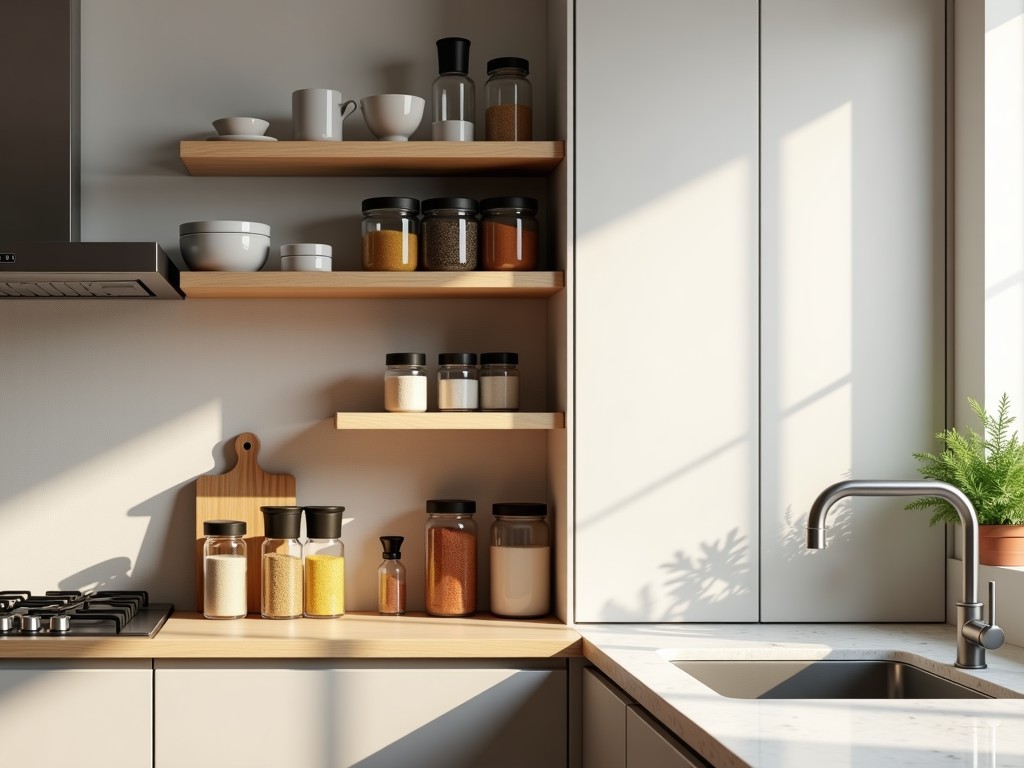
Built-In Spice Rack Cabinet
In commercial kitchens, food processing facilities, and institutional dining operations, efficient organization of dry ingredients directly impacts workflow speed, contamination control, and space utilization. A built-in spice rack cabinet addresses these challenges by integrating storage into existing cabinetry or wall systems, minimizing footprint while maintaining accessibility for high-turnover seasoning blends.
Engineering Perspective: Design for Hygienic Environments
Unlike freestanding racks that collect debris underneath or require frequent repositioning, a built-in configuration eliminates crevices where moisture and particulates accumulate. The design typically features a flush-mounted frame with sliding or pull-out trays, allowing full extension for inventory checks and restocking without removing the unit. This configuration supports compliance with FDA Food Code guidelines for cleanable surfaces and reduces labor associated with deep cleaning.
Material Selection: Balancing Durability and Sanitation
Material choice depends on exposure to cleaning agents, humidity levels, and load requirements. Stainless steel grade 304 is commonly selected for its resistance to corrosion from alkaline cleaners and its non-porous surface, which inhibits microbial retention. For environments with lower chemical exposure, such as dry spice storage in ambient conditions, powder-coated aluminum or high-density polyethylene (HDPE) may be used to reduce weight and material cost while maintaining ease of cleaning.
Manufacturing Process: Precision for Repeatable Installation
Production begins with CNC-cut panels to ensure dimensional consistency across units, critical for seamless integration into modular cabinetry. Edges are deburred and finished to a #4 brushed finish on stainless steel or smoothed and sealed on polymer trays to prevent snagging of packaging or cloth. Drawer slides are typically full-extension, ball-bearing type rated for 45–50 kg dynamic load, tested for 50,000 cycles to withstand daily use in high-volume operations.
Typical Specifications
| Parameter | Typical Value | Notes |
|---|---|---|
| Overall Height | 600–900 mm | Customizable to match cabinetry grid |
| Overall Width | 300–600 mm | Determined by spice jar diameter and quantity |
| Depth | 250–300 mm | Includes clearance for full extension |
| Material (Frame) | Stainless Steel 304 | Optional: 316 for high-chloride environments |
| Tray Material | HDPE or Stainless Steel | HDPE for lightweight; SS for heat resistance |
| Load Capacity per Tier | 15–20 kg | Evenly distributed; static rating |
| Finish | #4 Brushed (SS) or Powder Coat (Al) | No exposed threads or crevices |
Application Scenarios: Where Integration Adds Value
In central commissaries supplying multiple satellite kitchens, built-in spice racks are installed at eye level above prep stations, reducing reach time and minimizing cross-traffic. In food manufacturing lines where seasoning is applied post-cook, the rack is positioned adjacent to dosing equipment, enabling quick changeover between product runs. For bakery operations handling fine powders like cinnamon or nutmeg, the enclosed design prevents airborne particulate dispersion into mixing zones, supporting allergen control protocols.
Customization Options: Adapting to Specific Workflows
Customization begins with tray geometry—adjusting divider spacing to accommodate non-standard jar sizes (e.g., 45mm vs 60mm diameter) or integrating tilted fronts for gravity-fed dispensing. For facilities using color-coded lids for allergen identification, custom liners can be added to match coding systems. Depth and height can be modified to align with existing soffit clearance or to utilize vertical space in narrow galley layouts. All modifications are engineered to retain structural integrity and slide performance.
Packaging and Logistics: Protecting Finish During Transit
Units are packaged in triple-wall corrugated sheets with corner protectors and internal foam trays to prevent shifting. Stainless steel components are interleaved with VCI paper to inhibit oxidation during sea freight. Each package includes installation hardware, slide adjustment tools, and a cleaning manual specifying approved detergents and avoidance of abrasive pads. Palletized shipments are stretch-wrapped and labeled with handling instructions to maintain surface integrity upon delivery.
Quality Control: Consistency Across Production Runs
Dimensional inspection is performed on first article and every 50th unit using calibrated CMMs to verify mounting hole locations and slide alignment. Surface finish is assessed visually and with profilometers to ensure Ra values remain below 0.8 µm for stainless steel, preventing particle adhesion. Load testing is conducted on a sampling basis to validate slide performance under rated capacity. All inspections follow internal procedures aligned with ISO 9001 principles, with records available for review.
Installation and Maintenance: Reducing Downtime
Installation requires only standard cabinet screws and a level; no welding or specialized tools are needed. The unit is designed to sit within a prepared cabinet opening, with shims used to compensate for wall irregularities. Maintenance involves wiping surfaces with a pH-neutral cleaner and checking slide lubrication every six months—more frequently in high-humidity environments. No internal components require routine replacement under normal use.
To discuss how a built-in spice rack cabinet can be tailored to your facility’s layout, material handling requirements, or cleaning protocols, share your project specifications or cabinetry drawings with our engineering team.
We will provide a detailed proposal including material options, load calculations, and installation guidance.