B2B Black And White Kitchen Built In Cupboards
B2B Black And White Kitchen Built In Cupboards
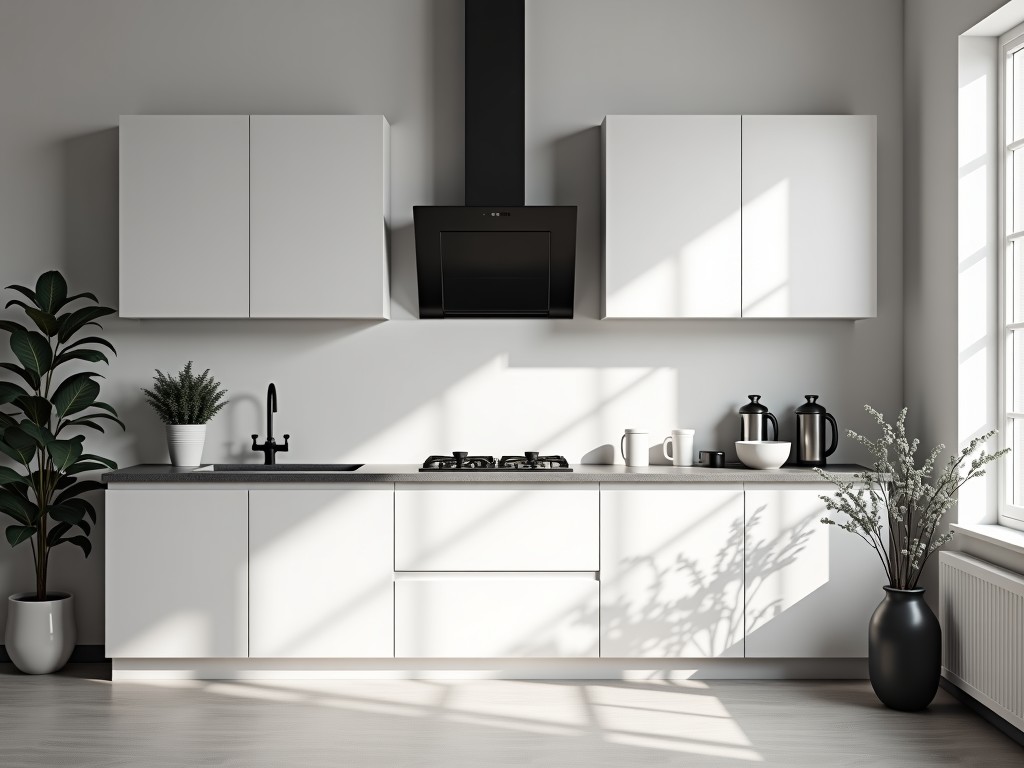
Engineering Specifications and Design of Black and White Built-In Cupboard Systems
Implementing a black and white kitchen built-in cupboard system requires a precise balance between aesthetic contrast and structural performance. In commercial and high-end residential environments, the selection of a monochromatic palette is not merely visual; it involves critical considerations regarding thermal stability, moisture resistance, and the durability of surface finishes. This technical guide outlines the manufacturing standards, material selection, and hardware requirements that ensure long-term operational integrity in high-traffic zones.
Material Selection for Structural Integrity
The core of any built-in system determines its lifespan under load and environmental stress. For professional-grade cabinetry, we prioritize high-density fiberboard (HDF) or moisture-resistant particle board (MRPB) for the carcass construction. The choice between black and white finishes often dictates the substrate requirements due to light absorption and pigment stability.
- Substrate: 18mm to 25mm thick marine-grade plywood to prevent sagging under the weight of heavy kitchen appliances.
- Surface Finish: High-pressure laminate (HPL) for superior resistance to abrasion and heat, or powder-coated matte finishes for a seamless, industrial aesthetic.
- Edge Banding: PVC or ABS banding applied with hot reactive adhesive to prevent moisture ingress into the core material.
Technical Challenges in High-Contrast Cabinetry
A primary challenge in black and white installations is the thermal expansion coefficient of different materials. Black surfaces absorb more thermal energy than white surfaces, which can lead to warping if the joints are not engineered correctly. To mitigate this, we utilize precision-cuted mounting systems that allow for slight movement without compromising the alignment of the doors.
| Technical Specification | White Finish Variant | Black Finish Variant |
|---|---|---|
| Light Reflectance (LR) | 80% - 95% (High Gloss/Satin) | 5% - 15% (Matte/Deep Charcoal) |
| Fingerprint Resistance | Standard resistance | Critical (Anti-fingerprint coating) |
| Thermal Stability | Low expansion | Requires expansion gap joints |
| Load Capacity | 25kg per linear meter (reinforced) | 25kg per linear meter (reinforced) |
Manufacturing and Assembly Standards
Precision is achieved through CNC machining, ensuring dimensional tolerances remain within ±0.5mm. This level of accuracy is vital for built-in cupboards where misalignment between black and white modules would be immediately visible. Our process involves a modular carcass design, allowing for rapid site installation while maintaining field adjustments for uneven architectural surfaces.
Hardware selection is the final critical step in the engineering process. We specify soft-close hinges and drawer slides rated for a minimum of 80,000 cycles. For black-finish hardware, we utilize electro--coated zinc alloy to prevent oxidation and peeling in high-humidity kitchen environments.
Maintenance and Lifecycle Management
To maintain the technical integrity of the surfaces, specific maintenance protocols are required. White surfaces require non-abrasive cleaners to prevent yellowing, while black surfaces, particularly matte finishes, require specialized microfiber cloths to avoid micro-scrating caused by improper pressure.
Frequently Asked Technical Questions
Can the black surfaces withstand high-steam environments?
Yes, when using HPL-grade laminates and moisture-resistant substrates. We recommend matte finishes for steam areas to hide water-vapor spotting.
What is the standard depth for built-in units?
Standard industrial depth is 600mm for base units, though wall units can be customized to 300mm or greater.
Can the black surfaces withstand high-steam environments?
Yes, when using HPL-grade laminates and moisture-resistant substrates. We recommend matte finishes for steam areas to hide water-vapor spotting.
What is the standard depth for built-in units?
Standard industrial depth is 600mm for base units, though wall units can be customized to 300mm or greater.
Are you requiring technical drawings or a custom quote for a project-scale installation?
Request Technical Specifications & Quote